Real Science-4-Kids Book 1
An easy-to-teach, engaging curriculum that helps kids apply real science to real life—building confidence, critical thinking, and problem-solving skills across all five core disciplines, with no required experiments and plenty of optional support.
$141.00
Quantity:


Nonreligious

Nonconsumable

In a Curriculum Kit
The Digital Dashboard is non-returnable.

2026 First-Grade Curriculum Kit
Real Science-4-Kids Book 1
Real Science-4-Kids Book 1 answers a question most science programs never stop to ask: What is science?
Before children can meaningfully study chemistry, biology, physics, geology, or astronomy, they need to understand what makes each field unique and how they fit together. Book 1 provides that foundation, introducing the five major branches of science in a clear, age-appropriate way that helps students see the big picture before diving into individual topics.
Rather than hopping from one unrelated science topic to another, Real Science-4-Kids helps children build a mental framework for understanding scientific study itself. Students learn what chemists investigate, how biologists differ from geologists, why astronomy is distinct from physics, and how each branch contributes to our understanding of the world.
The writing is approachable, the illustrations support comprehension, and the concepts are presented in a logical sequence that makes science accessible even to students just beginning their scientific journey. Parents appreciate that the program focuses on understanding rather than memorization, helping children develop true science literacy from the start.
For families who enjoy hands-on learning, optional experiments, notebook pages, quizzes, and lesson plans are available through the Digital Teaching Dashboard. The included digital flipbook with audio narration is particularly helpful for auditory learners, emerging readers, and students who benefit from hearing scientific vocabulary pronounced correctly.
Book 1 is an ideal starting point for young learners because it lays the foundation for all future science study. By the end of the course, students understand not only scientific facts but also how the major branches of science relate to one another and why scientists study the world the way they do.
What's Included?
Book 1 Text + Digital Dashboard Set includes the hardcover text and 18 months of access to the Digital Teaching Dashboard with lesson plans, answer keys, student notebook pages, lab activities, quizzes, grading tools, and audio narration. This is the version included in Timberdoodle's First-Grade Curriculum Kit.
Additional options include hardcover text-only, printed Student Pages, printed Teacher Pages, or Digital Dashboard access only.

Take a look inside the Real Science-4-Kids book here:
How to Use Real Science-4-Kids
- Plan to complete one chapter each week. With 22 chapters in the book, this pace fits comfortably into a typical school year while leaving room for breaks, field trips, and life's inevitable interruptions.
- Each chapter is divided into 5–11 short sections, making it easy to adjust the schedule to fit your family. Many families prefer to complete 4–5 sections per week, while others enjoy reading a section each day and finishing chapters more quickly.
- Read the lesson together or have your student read independently. The clear explanations and engaging illustrations make the material accessible. The audio-narrated digital flipbook provides additional support for auditory learners and emerging readers.
- Use the Student Pages, quizzes, and notebook activities as desired to reinforce learning. These optional resources help students process and apply what they have learned without turning science into a workbook-heavy subject.
- Experiments are entirely optional. If your family enjoys hands-on learning, choose activities from the Digital Teaching Dashboard that fit your schedule and interest level. If not, students can still gain a strong understanding of the material through the reading and discussion alone.
- Take time to discuss the ideas rather than rushing through them. Some of the best learning happens when students pause to ask questions, make connections, or relate new concepts to things they observe in everyday life.
Most importantly, keep science enjoyable. Real Science-4-Kids is designed to build understanding one step at a time, helping students develop a solid scientific foundation while maintaining the curiosity that makes science worth studying in the first place.
What's included?
- Book 1 Text + Digital Dashboard Set: Printed hardcover text plus 18 months of access to the Digital Teaching Dashboard. You'll get lesson plans, answer keys, student notebook pages, lab pages, and quizzes—all downloadable. The Book 1 Text digital flipbook with audio narration is especially helpful for auditory learners. With both a solid print foundation and flexible digital support, this is the set we include in the First-Grade Curriculum Kit.
- Book 1 Text Only: Printed hardcover text. A simple option for families who want to read, learn, and skip the extra structure.
- Book 1 Student Pages Only: Printed softcover Student Pages. These turn reading into doing, with notebook prompts, experiment ideas, and quick quizzes to reinforce each chapter. Prefer paper in hand? This gives you key pieces of the digital content, already printed.
- Book 1 Teacher Pages Only: Printed softcover Teacher Pages with four-day pacing guides, answer keys, and clear lab notes to make experiments approachable. A practical print option if you'd rather not rely on the dashboard.
- Book 1 Digital Dashboard Only: 18 months of access to the full Digital Teaching Dashboard, including lesson plans, student and teacher pages, labs, quizzes, and grading tools—plus the digital flipbook of the Book 1 Text with audio narration.
- 1.1 Introduction
- 1.2 History of Science
- 1.3 Building Blocks of Science
- 1.4 The Scientific Method
- 1.5 Summary
- 1.6 Vocabulary
- 2.1 Introduction
- 2.2 History of Chemistry
- 2.3 Modern Chemistry
- 2.4 Everyday Chemistry
- 2.5 Summary
- 2.6 Vocabulary
- 3.1 Atoms
- 3.2 Types of Atoms
- 3.3 Atoms Are Similar
- 3.4 Atoms Are Different
- 3.5 Summary
- 3.6 Vocabulary
- 4.1 Introduction
- 4.2 Atoms Form Molecules
- 4.3 Atoms Follow Rules
- 4.4 Summary
- 4.5 Vocabulary
- 5. 1 When Molecules Meet
- 5.2 Molecules Switch Atoms
- 5.3 Molecules Join Together
- 5.4 Molecules Break Apart
- 5.5 Reactions Are Everywhere
- 5.6 Reactions Follow Rules
- 5.7 We Can See Reactions
- 5.8 Summary
- 5.9 Vocabulary
- 6.1 Introduction
- 6.2 History of Biology
- 6.3 Modern Biology
- 6.4 Everyday Biology
- 6.5 Summary
- 6.6 Vocabulary
- 7.1 Studying Life
- 7.2 Sorting Living Things
- 7.3 Domains and Kingdoms
- 7.4 Sorting Within Kingdoms
- 7.5 Naming
- 7.6 Summary
- 7.7 Vocabulary
- 8.1 Living Things
- 8.2 The Cell
- 8.3 A Tiny City
- 8.4 Parts of a Cell
- 8.5 Summary
- 8.6 Vocabulary
- 9.1 Introduction
- 9.2 Viruses
- 9.3 Bacteria
- 9.4 Archaea
- 9.5 Summary
- 9.6 Vocabulary
- 10. 1 Introduction
- 10.2 History of Physics
- 10.3 Modern Physics
- 10.4 Everyday Physics
- 10.5 Summary
- 10.6 Vocabulary
- 11.1 Up the Hill
- 11.2 Force
- 11.3 Work
- 11.4 Energy
- 11.5 Summary
- 11.6 Vocabulary
- 12.1 Stored Energy
- 12.2 Types of Stored Energy
- 12.3 Releasing Stored Energy
- 12.4 Moving Energy
- 12.5 Summary
- 12.6 Vocabulary
- 13.1 Energy to Energy
- 13.2 Energy We Use
- 13.3 Energy We Waste
- 13.4 Finding Energy
- 13.5 Summary
- 13.6 Vocabulary
- 14.1 Introduction
- 14.2 History of Geology
- 14.3 Modern Geology
- 14.4 Everyday Geology
- 14.5 Summary
- 14.6 Vocabulary
- 15.1 Introduction
- 15.3 Dirt
- 15.4 Summary
- 15.5 Vocabulary
- 16.1 Shape of Earth
- 16.2 Size of Earth
- 16.3 Parts of Earth
- 16.4 Earth’s Layers
- 16.5 Summary
- 16.6 Vocabulary
- 17.1 Introduction
- 17.2 Volcanoes Erupt
- 17.3 Earthquakes Shake
- 17.4 Summary
- 17.5 Vocabulary
- 18. 1 Introduction
- 18.2 Who Was the First Astronomer?
- 18.3 Famous Early Astronomers
- 18.4 Astronomers Today
- 18.5 Summary
- 18.6 Vocabulary
- 19.1 Introduction
- 19.2 Earth Is a Planet
- 19.3 The Moon and Tides
- 19.4 The Sun and Weather
- 19.5 Eclipses
- 19.6 Summary
- 19.7 Vocabulary
- 20.1 Introduction 165
- 20.2 The Moon 165
- 20.3 The Sun 167
- 20.4 The Sun’s Energy 169
- 20.5 Summary 170
- 20.6 Vocabulary 171
- 21.1 Introduction 172
- 2 1.2 Planets 172
- 2 1.3 Two Types of Planets 173
- 2 1.4 Where’s Pluto? 176
- 21.5 Summary 177
- 21.6 Vocabulary 178
- 22.1 Science 179
- 22.2 All the Blocks Fit Together 180
- 22.3 Learning Science 181
- 22.4 Discoveries in Science 183
- 22.5 Summary 184
- 22.6 Vocabulary 184
Publisher: Gravitas Publications Inc
Author: Rebecca Woodbury, Ph.D., M.Ed.
Illustrator: Janet Moneymaker
Age Recommendation: 6
Grade Recommendation: 1st Grade
Faith-Based: No
Consumable: Text & Teacher Pages: No, Student Pages: Yes
ISBN: Text: 9781941181768, Teacher Pages: 9781950415052, Student Pages: 9781950415045
Format: Text: Hardcover book, Student & Teacher Pages: Paperback, Digital Dashboard: Online
Copyright: Text: 2024
Language: English

- Well-Trained Mind - Top Recommendation
- Cathy Duffy - One of 103 Top Picks for Homeschool Curriculum (2022)
- Practical Homeschooling - 2018 1st Place Reader Award
- Practical Homeschooling - 2018 3rd Place Reader Award
- Practical Homeschooling - 2015 Honorable Mention Reader Award
- Practical Homeschooling - 2014 Honorable Mention Reader Award
- About.com - 2012 Readers Choice Finalist
- Practical Homeschooling - 2009 2nd Place Reader Award
- Practical Homeschooling - 2009 3rd Place Reader Award
- Practical Homeschooling - 2008 Honorable Mention Reader Award
Explore two real Teacher Dashboards to see how chapter-by-chapter organization works.
Not sure where to start your student? Take their placement quiz to find out.

“Real Science-4-Kids builds a solid science foundation through clear, engaging lessons—bringing real science to life in a fun, approachable way, all without the stress of required experiments.” Read the Review.
Bina Walker:

Sunny in the Suburbs:

Find answers to the most frequently asked questions about this product below:
Yes. It is by the same author, but has been substantially updated.
What we love about the update is that it removes the pressure of experiments and lab notebooks while retaining rigorous scientific instruction. Plus, the redesigned books are a visual step up, too.
A simple guide to selecting the correct level by grade, reading ability, and parent involvement.
One of the most common questions we receive is:
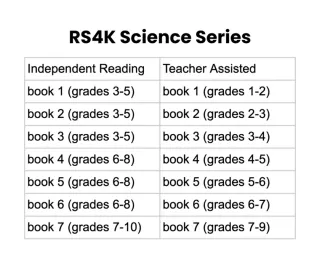
"Should my child start Science Book 1 in Grade 1, or wait until Grade 3?"
The answer depends on your child’s reading ability and whether you’ll be teaching with read-aloud support. RS4K’s atoms-first spiral model allows for flexibility — younger learners can begin with parent assistance, while independent readers may start at higher levels.
📖 Parent Note:
- Independent readers typically start Book 1 around Grade 3.
- Younger learners (Grades 1–2) can thrive with teacher read-aloud support.
- Strong readers in upper elementary may accelerate into Books 3–4.
✨ The goal is not to rush, but to build a strong, atoms-first foundation that will prepare your child for high school science and beyond.
Here’s our placement chart to guide your decision:


Customers earn Doodle Dollars for reviewing products they've purchased, and some promotions add an entry in a prize drawing. Rewards never depend on the rating given.